
Table of Contents
- 1. The Effects of Separating Technology Investment from Strategic Preparation
- 2. Common Problems of Transformation Processes That Begin Without a Roadmap
- 3. The Compatibility Problems Created by Technologies Selected Without a Needs Analysis
- 4. Making an Investment Decision Without Seeing the Level of Digital Maturity
- 5. The Fragmentation of Projects Not Linked to Corporate Priorities
- 6. The Consequences of Involving Departments in the Process Too Late
- 7. Implementing a Digital Solution Before the Data Infrastructure Is Ready
- 8. Expecting Technology Adoption Without Developing Employee Competencies
- 9. Hidden Costs in Budget, Time, and Resource Planning
- 10. Moving to Large-Scale Investment Without Designing a Pilot
- 11. Trying to Measure Impact Without Defining Success Criteria
- 12. Building a Phased Roadmap for Sustainable Transformation
- Investing Not in Technology, but in the Right Order of Transformation
For corporate companies, technology investments are no longer merely tools that provide operational efficiency; they are strategic moves that directly affect competitiveness, customer experience, decision-making speed, and new areas of growth. However, whether these investments can create the expected impact does not depend solely on selecting the right technology. The truly decisive factor is clarifying in advance for which need, in which order, with which teams, and by which measurement criteria the technology will be implemented.
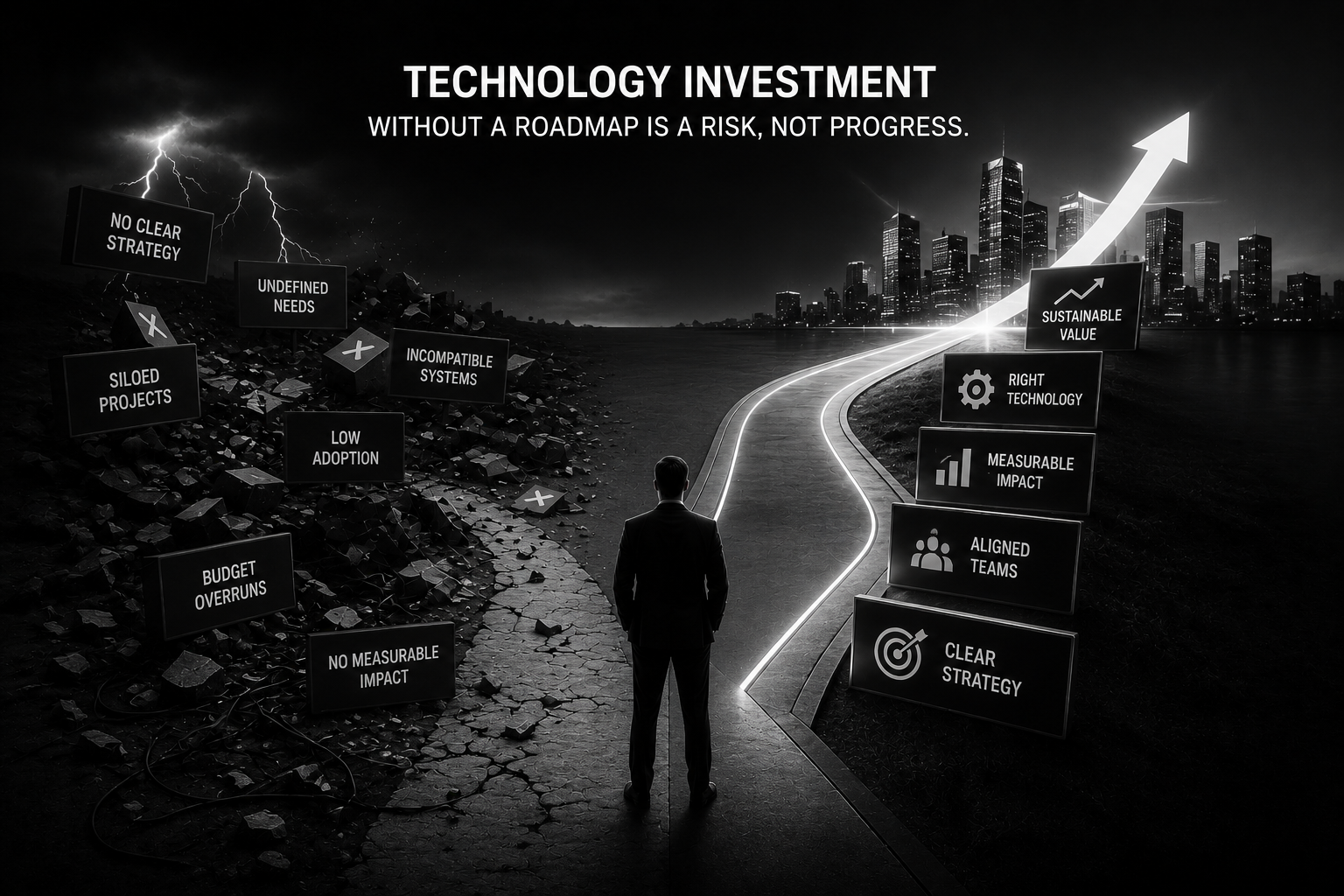
Many companies feel pressure to take quick action once they recognize the need for digital transformation. Purchasing a new piece of software, an automation solution, an artificial intelligence tool, or a data platform can look like a strong sign that transformation has begun. But steps taken without strategic preparation can turn over time into scattered projects, low adoption rates, incompatible systems, and investments that do not produce the expected value. A technology investment made without a transformation roadmap often creates new confusion before it creates a solution.
For this reason, before starting a technology investment, corporate companies need to evaluate their current situation, priority needs, organizational capacity, and implementation steps in a holistic way. The value of technology arises not from the tool owned on its own but from how that tool is linked to the company’s strategic goals.
1. The Effects of Separating Technology Investment from Strategic Preparation
Technology investment is often treated as a decision expected to produce quick results. However, technology decisions made without strategic preparation may create momentum in the short term but may not strengthen corporate transformation capacity in the long term. Because technology does not produce value simply because it is purchased. Value emerges when technology is placed in the right problem, the right process, and the right user group.
When strategic preparation is lacking, companies may select a tool without clarifying which need they are trying to solve. This blurs the goal of the project. Will a technology solution be used for operational efficiency, to improve customer experience, to accelerate decision-making processes, or to create new revenue areas? An investment made without answering these questions creates a cost of trial and error rather than transformation.
2. Common Problems of Transformation Processes That Begin Without a Roadmap
In transformation processes without a roadmap, the first problem is usually confusion over priorities. Each department may see its own need as urgent, different teams may turn to different tools, and a holistic transformation language may not form within the company. This situation leads to weakly connected projects starting at the same time.
The second problem is that decisions remain dependent on personal initiative. Without a strong roadmap, projects may advance through the interest of certain managers, but corporate ownership remains weak. In cases such as a change of manager, a budget revision, or a shift in team priorities, the transformation process can easily slow down. A roadmap takes transformation out of personal effort and moves it into a corporate governance structure.
3. The Compatibility Problems Created by Technologies Selected Without a Needs Analysis
Before selecting technology, a company’s real needs must be understood. In which processes is there inefficiency, which customer touchpoints are weak, which decisions are not sufficiently supported by data, which teams lose time due to manual workload? Technologies selected without answering these questions may not be compatible with the company’s core problems.
The compatibility problem is not limited to technical integration alone. A solution must also be compatible with the current way of doing business, employee habits, data organization, and the decision-making model. For this reason, technology selection should be evaluated not only through product features but through the company’s transformation need.
4. Making an Investment Decision Without Seeing the Level of Digital Maturity
One of the most critical starting points in companies’ digital transformation processes is understanding the current level of maturity. Making a technology investment without analyzing areas such as data infrastructure, process standardization, team competence, system integration, and management ownership is risky. Because a technology for which the company is not ready may create difficulty of use instead of producing the expected impact.
Digital Maturity Analysis, by making the company’s current digital capacity visible, reveals which areas require development. This analysis offers a more realistic basis for the order in which technology investments should be made. In this way, companies can focus not on technologies that merely appear current but on transformation steps suited to their own level of maturity.
5. The Fragmentation of Projects Not Linked to Corporate Priorities
For technology projects to succeed, they must establish a direct connection with the company’s strategic priorities. If the company’s priority is to increase customer loyalty, the technology investment may focus on better understanding customer data, personalizing the experience, or improving service processes. If the priority is operational efficiency, process automation and data visibility may become more critical.
When this connection is not established, projects fragment. Each team builds a different technology agenda according to its own need, and resources are split across the company. Digital Transformation Program, while rethinking business processes through technology, supports building a stronger link between strategic goals and implementation steps.
6. The Consequences of Involving Departments in the Process Too Late
Technology investments are often initiated by central teams but require the active contribution of many departments during implementation. Sales, marketing, finance, human resources, operations, customer experience, and technology teams take part at different points of the transformation. When these teams are involved in the process too late, resistance, incompatibility, and a lack of ownership can arise.
Involving departments in the process at an early stage enables needs to be understood more accurately. It also makes operational obstacles that may arise during implementation visible in advance. In-House Innovation Program, by supporting more active participation of employees and different teams in innovation processes, prevents transformation decisions from remaining only in top-level plans.
7. Implementing a Digital Solution Before the Data Infrastructure Is Ready
Many technology solutions require a healthy data infrastructure. Artificial intelligence, analytics platforms, customer experience tools, or automation systems create limited impact without accurate and accessible data. In structures where data is scattered, incomplete, or inconsistent, digital solutions struggle to produce the expected benefit.
For this reason, before a technology investment, it should be evaluated where data is stored, how it is processed, by which teams it is used, and how it is incorporated into decision-making processes. Data readiness is often the fundamental issue that must be resolved before technology. Otherwise, even if the company owns an advanced tool, it cannot use that tool efficiently.
8. Expecting Technology Adoption Without Developing Employee Competencies
The success of technology transformation is directly related to how much employees adopt the new tools. Technologies implemented without considering users’ needs, habits, and competencies may encounter low adoption rates. When employees do not understand why they should use the new system, the tendency to return to old methods grows stronger.
At this point, training, communication, and participation processes become critical. Entrepreneurship Trainings and Workshops, by strengthening employees’ skills in problem solving, innovation development, and understanding new business models, enable them to take part in transformation processes more prepared. Technology adoption becomes possible not through technical training alone but through employees understanding the purpose of the change.
9. Hidden Costs in Budget, Time, and Resource Planning
In technology investments made without a roadmap, hidden costs frequently emerge. The license fee or implementation cost may be clear at first glance, but items such as integration, training, data cleaning, process design, internal communication, maintenance, and change management may not be adequately calculated at the outset.
This situation creates budget pressure in the later stages of the project. The timeline extends, the workload of teams increases, and the gap between management expectations and implementation reality widens. A healthy roadmap makes visible not only which technology will be acquired but also the total impact of the investment and the resources it will require.
10. Moving to Large-Scale Investment Without Designing a Pilot
Moving directly to large-scale implementation in technology investments can create serious risks. Every solution may not create the same impact within the company’s own structure. For this reason, controlled pilot implementations allow the technology to be tested under real conditions.
Corporate–Startup Collaboration (Scouting & PoC), as an approach, helps companies identify startups aligned with their strategic needs and design PoC processes in a more controlled way. A pilot is not only technical validation. It is also a learning space that tests user experience, process compatibility, data needs, measurement criteria, and scaling potential.
11. Trying to Measure Impact Without Defining Success Criteria
When success criteria are not defined from the start in transformation projects, it becomes difficult to evaluate the real impact of the investment. Which indicators are expected to improve at the end of the project? Time savings, cost reduction, customer satisfaction, revenue growth, employee productivity, decision-making speed? Evaluations made without clarifying these indicators often remain subjective.
Success criteria also determine the direction of the technology investment. When teams know what they are trying to achieve, the implementation process advances in a more focused way. Measurability is one of the fundamental elements that distinguishes transformation projects from well-intentioned initiatives. For this reason, every investment decision should be designed together with its targeted areas of impact and its measurement method.
12. Building a Phased Roadmap for Sustainable Transformation
A healthy transformation roadmap offers a phased structure that shows how the company will move from its current situation to the targeted future. This structure should include the steps of current-situation analysis, prioritization, identification of technology areas, pilot implementation, measurement, learning, and scaling.
A phased roadmap prevents the company from trying to change everything at once. Instead, it ensures a start from the areas that can create the highest strategic impact. Sector Reporting and Case Analyses, by evaluating market dynamics and similar implementation examples, can help companies make more informed decisions. In this way, the roadmap becomes sensitive not only to internal needs but also to changes in the outside world.
Investing Not in Technology, but in the Right Order of Transformation
For corporate companies, technology investment may have become inevitable, but the real issue, before which technology to invest in, is which order of transformation to follow. Projects launched without a roadmap may look strong at the beginning but can encounter problems of ownership, compatibility, measurement, and scaling over time.
A transformation roadmap enables companies to manage their technology decisions in a more conscious, more controlled, and more sustainable way. Understanding the current level of maturity, identifying priority needs, involving employees in the process, learning through pilot implementations, and clarifying success criteria make it possible for technology investments to produce real value.
Companies preparing for the future should see technology not merely as a solution to be purchased but as part of the process of building strategic capacity. As this perspective strengthens, technology investments cease to be scattered projects and turn into lasting transformation tools that support the company’s competitiveness, agility, and sustainable growth potential.