Investment - INVEXEN
INVEXEN
  • Home
  • Fund of Funds
    • For VC Funds
    • For Investors
  • Advisory Services
    • VC/CVC Fund Management
    • Corporate Innovation Acceleration
  • Academy
  • Resources
    • Blog
    • News
  • About Us
  • Contact Us
  • ENG
    • TR

Eğitim Kataloğudownloadiconn

    TRAINING CATALOG

    If you have any questions, you can contact us via academy@invexen.com mail.

    If the download has not started, you can also download it by clicking here.

    Your information will be securely sent to and stored in Google Sheets for the purpose of processing your form submission.

    Apply Now
    Menu
    INVEXEN

    Eğitim Kataloğudownloadiconn

      TRAINING CATALOG

      If you have any questions, you can contact us via academy@invexen.com mail.

      If the download has not started, you can also download it by clicking here.

      Your information will be securely sent to and stored in Google Sheets for the purpose of processing your form submission.

      Apply Now
      As corporate interest in AI startups grows, the central challenge is increasingly not finding companies, but comparing them within a consistent decision logic. A startup may present an impressive technical team and a compelling demonstration, yet still struggle to create value if its solution does not address a priority problem, cannot access the required data, or cannot integrate safely with existing systems. Evaluation therefore needs to extend beyond technological novelty and cover the path from strategic fit to implementation readiness. An AI startup evaluation score reduces the ambiguity created when different functions examine the same company through different lenses. Innovation teams may focus on strategic potential, technology teams on architecture, legal and information security on risk, and business owners on process impact. The purpose of the score is not to automate a decision through one number, but to make the assumptions behind that decision explicit. Used well, the score becomes a common reference from scouting and shortlisting through PoC selection and scaling. 1. An evaluation score creates a shared decision language before investment One of the most common weaknesses in startup evaluation is that every stakeholder applies a different definition of success. A business owner may prioritize speed, while technology teams focus on architecture, procurement on commercial terms, and legal on contractual exposure. Each perspective matters, but without a common framework meetings can produce opinions rather than decisions. An evaluation score brings these perspectives together under predefined criteria. The scorecard should show not only the total result but also where the startup is strong or weak. A low score can then be traced to strategic misalignment, technical limitations, poor data readiness, or a gap in corporate preparedness. Sectoral Reporting and Case Analyses can support the criteria with market dynamics and comparable use cases, preventing the scorecard from becoming an abstract checklist. 2. Strategic fit should be assessed before technological sophistication Even a highly capable AI startup may have limited corporate value if it does not connect to a priority objective. Strategic fit should test whether the solution contributes to revenue growth, cost efficiency, customer experience, risk management, employee productivity, or a new business model. The task is not to accept broad benefit statements from a pitch, but to establish a direct link between the solution and a concrete corporate priority. Timing matters as well. A topic may be strategically important but not yet ready for a PoC because budget, ownership, or data foundations are missing. A Digital Maturity Assessment can make process, data, and technology readiness visible, helping teams distinguish strategic importance from near term implementation readiness. 3. Problem significance and the use case reveal whether the need is real Startup presentations usually emphasize what the product can do. Corporate evaluation should begin with how important the underlying problem is. The score can consider current cost, delay, error exposure, customer impact, and employee workload. The use case should then define precisely which step AI changes and how that change is expected to produce value. A strong use case identifies the user, current workflow, decision point, and expected change. Saying that a platform “analyzes documents with AI” is not enough; the evaluation should establish which documents, for which users, and which decision or risk the capability improves. When the problem is unclear, technical performance is not a reliable proxy for corporate value. 4. AI capability must be translated from technical claims into measurable performance Assessing AI capability requires more than reviewing the model type, technical architecture, or an “AI-first” positioning. Corporate buyers need to know whether the solution delivers consistent, explainable, and controllable performance in the target use case. Evaluation should therefore cover performance evidence, failure modes, human oversight, output validation, and the conditions under which the model is likely to underperform. Dependence on proprietary or third party models should also be visible. A startup whose core capability is entirely dependent on an external model has a different risk profile from one that creates defensible value through proprietary data, workflow integration, evaluation layers, or domain expertise. The technical score should measure demonstrated capability in the use case, not the technology label. 5. Data readiness and integration requirements determine feasibility In many AI projects, the bottleneck appears in data before it appears in the model. The score should ask whether the required data exists, can be accessed, is sufficiently reliable, and can be used lawfully. When these questions remain unresolved, a PoC can spend weeks on access, cleaning, and mapping before the core value proposition is ever tested. Integration criteria should cover APIs, authentication, cloud or on premises options, system interfaces, and ownership of ongoing maintenance. Corporate-Startup Collaboration (Scouting & PoC) can clarify these requirements during shortlisting and help define a realistic PoC scope. Feasibility should measure not only whether integration is possible, but the time, resources, and dependencies required to achieve it. 6. Product maturity should be assessed against corporate operating conditions Product maturity should not be reduced to customer count or company age. Corporate use can require release management, support processes, issue tracking, availability, service continuity, and a credible product roadmap. An early stage startup may show strong discipline for a narrow use case, while a more established product may still fail to meet corporate operating requirements. The score should therefore measure the gap between the current product and the minimum conditions required for the intended stage. Readiness for a PoC is different from readiness for enterprise wide procurement. Matching the maturity threshold to the decision stage prevents promising early stage startups from being rejected while keeping the relevant risks visible. 7. Security, legal, and governance requirements belong in the score from the start Leaving security and legal review until the end can cause a promising startup to be rejected just before the PoC or force the use case to be redesigned. Data processing methods, sensitive information, retention, access rights, output usage, and third party dependencies should be assessed early. Risk functions should not only identify constraints; they should define the conditions under which safe experimentation is possible. Governance criteria should also address human oversight, accountability when errors occur, auditability, and the management of model changes. Higher impact decisions can require stricter thresholds. When these factors are explicit in the scorecard, security and compliance become part of solution design rather than a late stage control point. 8. Team quality and corporate collaboration capacity should be assessed together For early stage startups, the ability of the team to learn and adapt can matter as much as the current product. Evaluation should consider the founders’ understanding of the problem, technical depth, speed of incorporating customer feedback, and discipline in working with corporate stakeholders. Strong credentials alone do not guarantee a productive partnership. Corporate collaboration also requires the startup to clarify ambiguous requirements and communicate consistently during a PoC. Corporate-Founder Workshops can bring founders, business owners, and technical teams together around the same challenge, making both problem fit and working style observable. The team score should measure not only what the startup knows, but how effectively it can learn with the company. 9. Commercial structure and scalability test long term sustainability If selection is based only on PoC performance, pricing, licensing, or capacity constraints may emerge later. Commercial evaluation should cover the pricing model, unit economics logic, contract structure, cost behavior as usage grows, and support requirements. The objective is not to demand perfect forecasts from an early stage company, but to understand whether the economics of scaling are credible. Scalability also includes the technical and operational implications of expanding the solution across functions, countries, or processes. A product may work well with one team’s data but require significantly stronger integration and support to operate at company scale. The commercial score tests whether the relationship can remain sustainable after a successful PoC, not simply whether the current price is attractive. 10. Score weights should reflect the company’s strategic priorities Equal weighting is convenient, but rarely appropriate for every company or use case. A solution processing customer data may require heavier weighting on security and data governance. An operational optimization tool may place greater emphasis on integration and measurable efficiency, while a new business model initiative may prioritize differentiation and market potential. Weights should be set and calibrated with stakeholders before evaluating candidates. Changing them after seeing a preferred startup can distort the model. A practical scorecard can include the following building blocks: • Strategic fit and problem significance • AI capability and product maturity • Data, integration, and security readiness • Team and collaboration capacity • Commercial sustainability and scaling potential Defining weights in advance makes the comparison more consistent and defensible. 11. Red flags should create decision gates independent of the total score Some risks should not be offset by a high total score. A critical security weakness, an integration requirement that cannot be met, unresolved core intellectual property, or a failure to satisfy mandatory operating conditions may justify a separate decision gate. Strong commercial potential should not be allowed to obscure an unacceptable risk. Red flags should be defined before the process begins. They do not all need to mean automatic rejection; some may require remediation before a PoC, some may require a narrower scope, and others may stop the process. The scorecard ranks opportunity, while decision gates protect the minimum conditions for acceptability. 12. The evaluation score should translate directly into PoC design and the next decision The strongest scorecard is not a document that is completed in an evaluation meeting and then archived. Its output should determine what the PoC needs to test. If data readiness is weak, the first milestone should validate access and quality. If product maturity is uncertain, support capacity and issue management should become explicit parts of the test. Within Corporate-Startup Collaboration (Scouting & PoC), each shortlisted candidate can connect its strengths and weaknesses to PoC success measures and stopping conditions. The same criteria can then be reassessed after the PoC to show which assumptions were validated. The real value of an evaluation score is not that it ranks startups, but that it produces a better next decision. Building a decision system that is stronger than a single score As the number of AI startups expands, corporate advantage will come less from seeing the largest pipeline and more from selecting the right company for the right problem. A systematic evaluation score brings strategy, technology, data, risk, team quality, and commercial sustainability into one decision architecture. Innovation decisions become less dependent on personal preference or the quality of a pitch. The objective is not to build a perfect scoring model. The objective is to structure uncertainty, expose critical assumptions early, and direct PoC resources toward opportunities with the highest learning value. When the scorecard is reviewed and improved over time, the company develops not only a better way to assess today’s AI startups, but a reusable institutional capability for evaluating future technology shifts.
      05 Oct
      All, Investment

      AI Startup Evaluation Score for Corporate Companies: From Strategic Fit to PoC Readiness

      • 5 October 2026
      • author-avatar INVEXEN By
      As corporate interest in AI startups grows, the central challenge is increasingly not finding companies, but comp...

      Continue reading

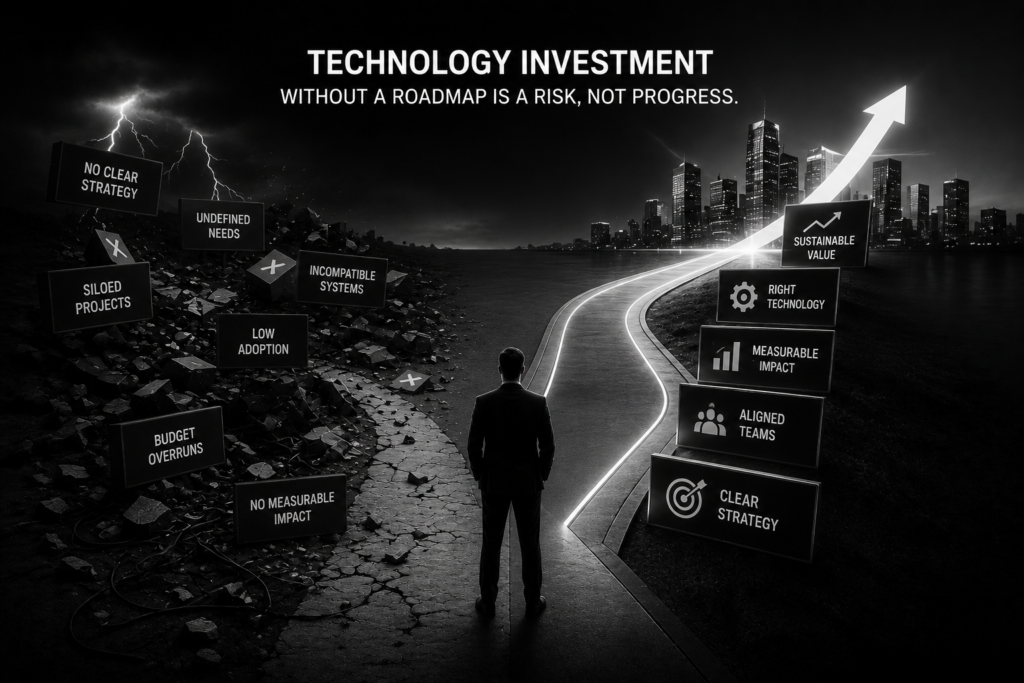
      The Risks of Starting Technology Investment Without Creating a Transformation Roadmap
      04 Aug
      All, Investment, Strategy

      The Risks of Starting Technology Investment Without Creating a Transformation Roadmap

      • 4 August 2026
      • author-avatar INVEXEN By
      For corporate companies, technology investments are no longer merely tools that provide operational efficiency; t...

      Continue reading

      Directing Corporate Resources to the Right Areas Through Innovation Portfolio Management
      30 Jun
      All, Investment, Strategy

      Directing Corporate Resources to the Right Areas Through Innovation Portfolio Management

      • 30 June 2026
      • author-avatar INVEXEN By
      In corporate companies, innovation efforts often progress across different departments, through the initiatives o...

      Continue reading

      Yatırım Turu Danışmanlığı Nedir? Girişimlerin Yatırım Sürecine Kurumsal Hazırlığı Nasıl Sağlanır?
      21 Oct
      All, Investment

      What Is Fundraising Advisory? How Do Startups Achieve Corporate Readiness for the Investment Process?

      • 21 October 2025
      • author-avatar INVEXEN By
      1. What Is Fundraising Advisory?Fundraising advisory is a profess...

      Continue reading

      Hackathon Etkisi: 48 Saatte İnovasyonu Ateşlemek
      22 Nov
      All, Competitive, Investment, Productization

      External Acceleration Programs: Strategic Partnerships and Opportunities

      • 11 March 2025
      • author-avatar INVEXEN By
      In today’s business world, success no longer relies on traditional methods but on the ability to explore new path...

      Continue reading

      OyunEkosistemineGirmeninYollari
      16 Oct
      All, Investment, Strategy

      Ways for Corporate Companies to Enter the Gaming Ecosystem

      • 11 March 2025
      • author-avatar INVEXEN By
      In today's rapidly digitalizing world, the gaming industry has become one of the most dynamic and fastest-growing...

      Continue reading

      InovasyonLideri
      16 Oct
      All, Investment

      Pioneers of Intrapreneurship: Innovation Leaders Within Companies

      • 11 March 2025
      • author-avatar INVEXEN By
      The business world is rapidly evolving, and one of the most critical ways to keep pace with this change is by enh...

      Continue reading

      StratejikAdimlar
      16 Oct
      All, Growth, Investment, Strategy

      Gaining Competitive Advantage Through Internal Innovation: Strategic Steps

      • 11 March 2025
      • author-avatar INVEXEN By
      In today’s business world, adapting to constantly changing conditions has become essential for survival. In such ...

      Continue reading

      kurumsa firmalarda girisimcilik donusumu
      16 Oct
      All, Idea Phase, Investment, Productization

      Entrepreneurial Transformation in Corporate Firms: A New Success Strategy for Companies

      • 11 March 2025
      • author-avatar INVEXEN By
      In today’s business world, traditional methods are no longer sufficient for companies to achieve sustainable grow...

      Continue reading

      KurumsalSermayeninGirisimDunyasindakiGelecegi
      16 Oct
      All, Investment, Strategy

      The Future of Corporate Venture Capital in the Startup Ecosystem

      • 11 March 2025
      • author-avatar INVEXEN By
      The startup ecosystem has undergone a significant transformation in recent years, driven by the increasing presen...

      Continue reading

      • 1
      • 2
      • 3

      INVEXEN is an Istanbul-based international consulting firm that focuses on technology and entrepreneurship, transforming and growing companies through strategic consulting services and trainings.

      info@invexen.com

      © INVEXEN. All Rights Reserved.
      Fund of Funds

      For VC Funds
      For Investors

      Advisory Services

      VC/CVC Fund Management
      Corporate Innovation & Acceleration

      INVEXEN Academy Services

      Corporate Innovation
      Corporate Entrepreneurship
      Corporate Venture Capital
      All for Corporations

      Company

      Blog
      News
      About Us
      Contact Us


      © 2026 INVEXEN. All rights reserved

      Gizlilik Politikası
      • .
      • Home
      • Fund of Funds
        • For Investors
        • For VC Funds
      • Advisory Services
        • VC/CVC Fund Management
        • Corporate Innovation Acceleration
      • Academy
      • About Us
      • Contact Us
      • ENG
        • TR